Product Innovation | Mechanical Engineering
Non-Condensing Toilet Cistern
An innovative engineering solution to a long-standing household problem.
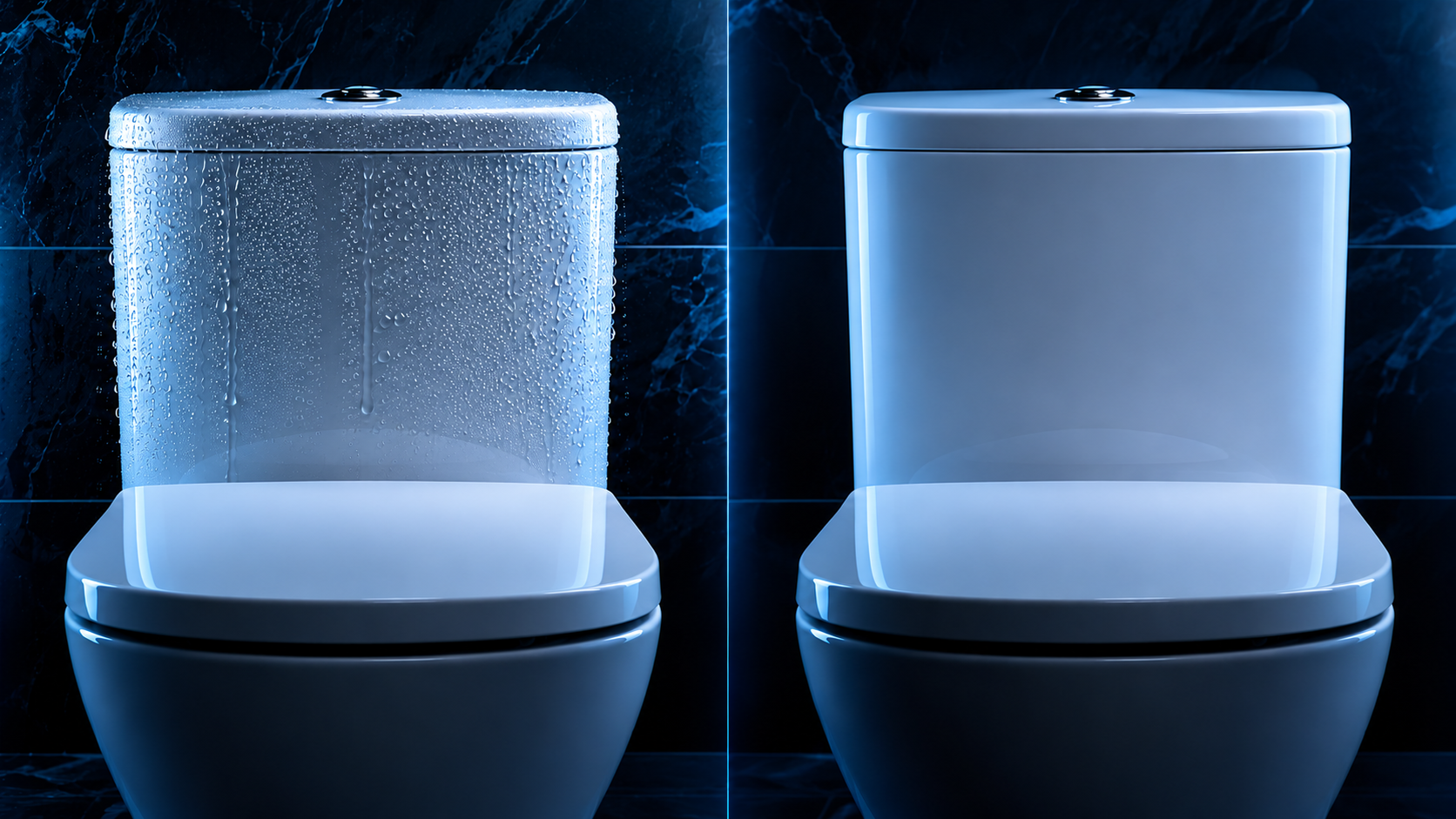
Understanding the Problem
Condensation forming on the outside of toilet cisterns is a common problem in homes, particularly where humidity levels are high or there is a significant temperature difference between the water inside the cistern and the surrounding room.
In the United Kingdom, this is especially noticeable during the colder winter months, when bathrooms are heated but the incoming mains water can be extremely cold. However, the problem is not restricted to colder climates. In many countries, substantial temperature differences can occur throughout the year, meaning cistern condensation can also be a problem during the summer.
When warm, moisture-laden air comes into contact with the cold exterior of a toilet cistern, water vapour can condense into droplets on the ceramic surface. This phenomenon is commonly referred to as cistern sweating.
Under particularly humid conditions, condensation can become severe enough for droplets to collect and run down the outside of the cistern, eventually dripping onto the floor.
Homeowners may reasonably mistake this for a leaking toilet or faulty plumbing, when the real cause is condensation.
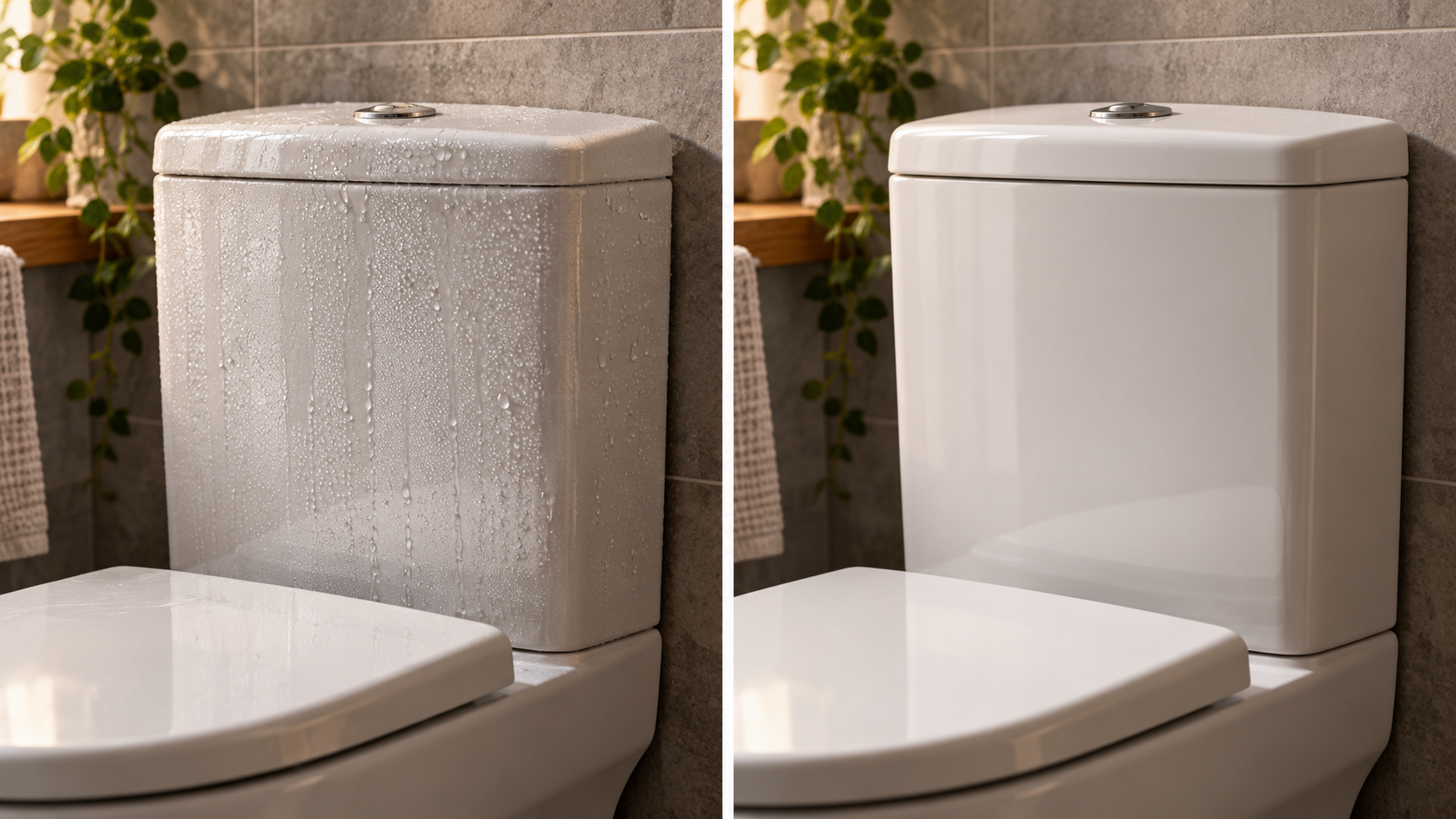
More Than an Inconvenience
Although cistern condensation is often dismissed as a minor bathroom nuisance, persistent moisture can have much more serious consequences.
Water repeatedly collecting around a toilet can gradually penetrate flooring and surrounding materials. In properties with timber construction, prolonged exposure to moisture can contribute to deterioration of floorboards, joists and other structural components.
What initially appears to be a small amount of condensation can, over time, result in substantial repair costs. In more serious cases, the damage may run into thousands of pounds, particularly where flooring or structural timber requires replacement.
The problem is not necessarily immediately obvious. Moisture may accumulate behind the toilet or beneath floor coverings, allowing deterioration to continue before the homeowner recognises what is happening.
Why Conventional Solutions Fall Short
A variety of approaches have been used to combat toilet cistern condensation.
One method involves introducing warmer water into the cistern, reducing the temperature difference between the stored water and the surrounding air. This can require additional plumbing arrangements, including mixing or diverter valves connected to the water supply.
Another approach involves insulating the cistern internally, sometimes using polystyrene or other insulating materials to reduce the cooling effect of the stored water on the outside of the tank.
Although these methods can help reduce condensation, they introduce their own limitations.
Internal insulation can reduce the available space inside the cistern and, depending on the installation, affect the usable flushing volume. Water-temperature management can require additional components, installation work and ongoing consideration of the plumbing arrangement.
Most importantly, these approaches do not necessarily eliminate the conditions that allow condensation to occur.
They generally attempt to manage the problem rather than remove it entirely.
A Fundamentally Different Approach
AVO Invents has developed an alternative approach to the problem, based on a different way of addressing the conditions responsible for cistern sweating.
Rather than relying on conventional insulation or mixing warmer water into the supply, the concept has been engineered with the objective of making external cistern condensation physically impossible under its intended operating conditions.
The ambition is not simply to reduce condensation or make it less noticeable, but to eliminate the underlying problem.
This has been approached as a practical engineering challenge, with particular attention given to maintaining the familiar function and appearance of a conventional toilet while addressing a persistent weakness in existing designs.
The underlying operating principle is proprietary and is not disclosed publicly.
Development of a Bespoke Equilibrium Valve
An additional part of the development involved creating a bespoke equilibrium valve.
Conventional equilibrium-type valves can encounter limitations where the available water pressure is particularly low. Some designs can also restrict water flow, affecting how quickly a system operates.
The valve developed for this project was intended to overcome these limitations while maintaining strong water flow.
Particular attention was given to the challenges faced by properties with low mains water pressure, where conventional arrangements may perform poorly.
This aspect of the project demonstrates that the development was not limited to addressing condensation alone. Supporting components were also considered and developed to avoid introducing new performance compromises.
The precise design and operation of the valve remain confidential.
The Intended Benefits
The concept has been developed around several clear objectives:
- Prevent condensation forming on the exterior of the toilet cistern.
- Reduce the risk of persistent moisture damaging surrounding flooring and timber.
- Avoid the need for conventional internal cistern insulation.
- Avoid reliance on introducing warmer water into the cistern.
- Preserve effective flushing performance.
- Support reliable operation in properties with lower water pressure.
- Maintain a familiar, practical toilet design.
Innovation Through Practical Problem-Solving
This project reflects the wider engineering approach taken by AVO Invents: identifying an everyday problem that has persisted despite existing solutions, examining why those approaches remain limited, and developing a different technical solution.
The intention is to deliver a practical improvement without requiring the end user to understand the engineering behind it.
The project also demonstrates independent mechanical design and component development, including the creation of a specialised valve to address performance considerations.
Project Status and Confidentiality
Independent design and development.
The underlying engineering principle and component designs remain confidential.
The images shown are illustrative representations of the condensation problem and the intended benefit. They are not disclosures of the internal construction, nor do they independently verify performance.
Commercial availability, certification and independently verified performance are not claimed on this page.