3D Mapping, SLAM & AI / Healthcare Research
Intelligent Healthcare Navigation & Patient Assistance
Research & Feasibility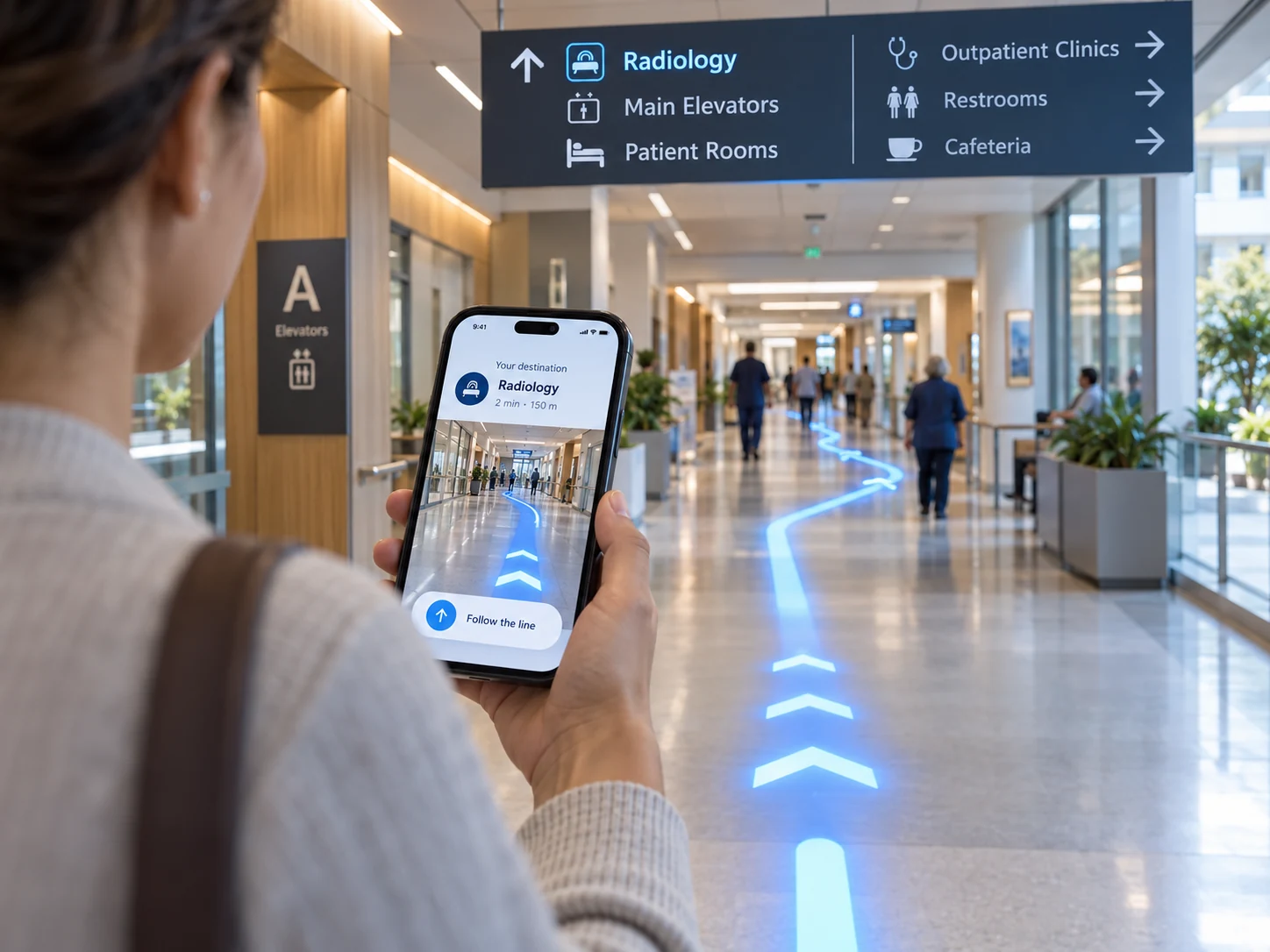
Helping patients find their way. Helping hospitals make better use of their time.
Navigating a large hospital can be challenging. Complex layouts, multiple floors, unfamiliar departments and changing building configurations can leave patients confused, stressed or late for appointments.
For healthcare providers, these difficulties contribute to missed appointments, wasted clinical time and additional administrative costs.
AVO Invents is researching a new approach to indoor hospital navigation, combining purpose-developed 3D mapping technology, intelligent positioning software, augmented reality and AI-assisted patient services.
Our objective is to create a simple, accessible navigation system that works reliably in complex healthcare environments, while helping hospitals reduce unnecessary costs and improve patient experience.
The Wayfinding Challenge
Our research focuses on practical challenges in mapping, positioning and maintaining digital hospital environments.
The aim is to help patients reach appointments with greater confidence. Any impact on missed appointments, patient experience and costs would need to be established through evaluation.
Building Our Own 3D Mapping Technology
At the centre of our proposed system is the development of dedicated hardware and software for digitally mapping complex indoor environments.
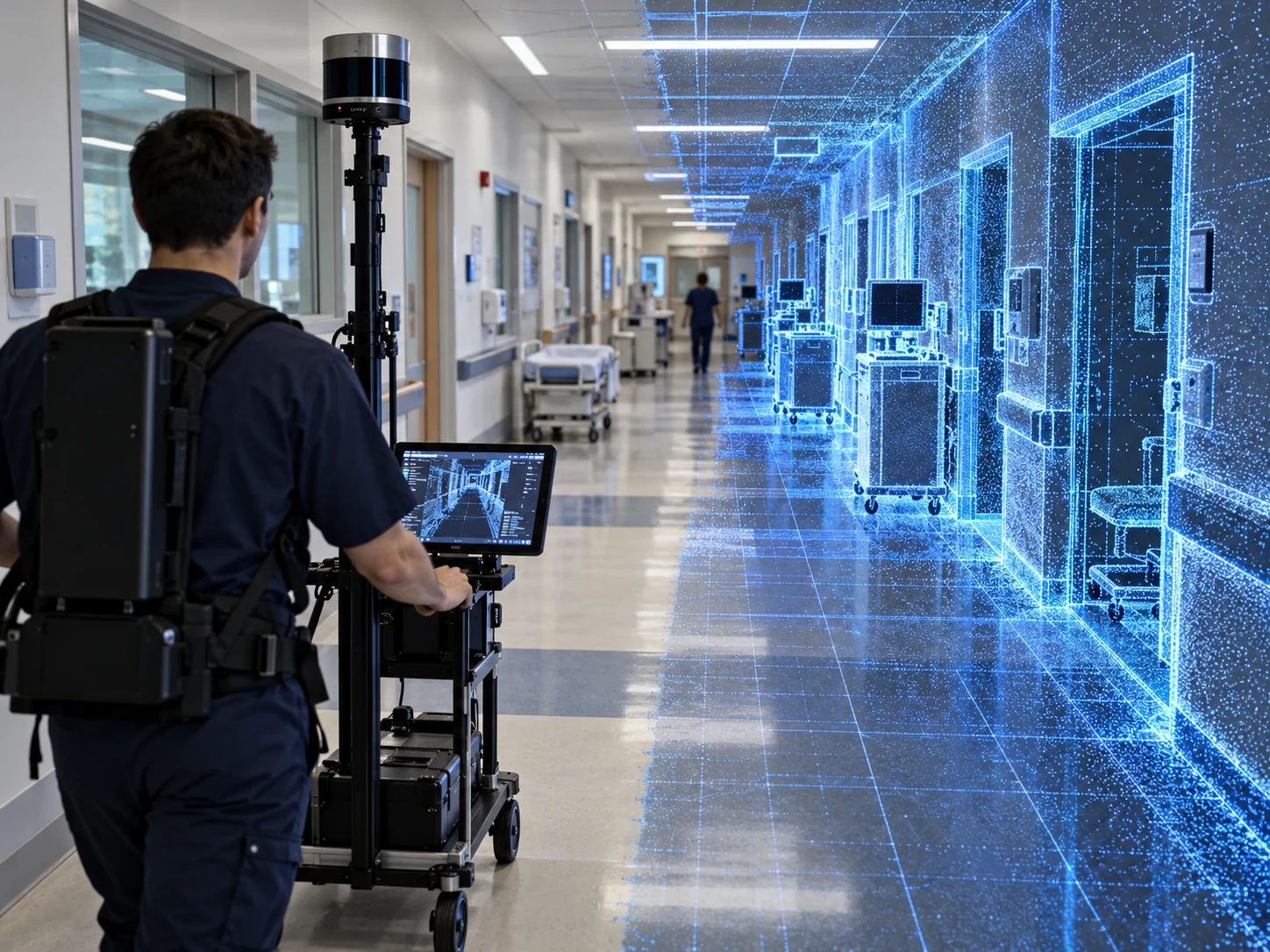
Using technologies such as LiDAR, depth sensing, inertial measurement and Simultaneous Localisation and Mapping (SLAM), we aim to create detailed digital representations of hospital buildings.
Our proposed scanning equipment could be carried by an operator or mounted on a mobile platform, allowing corridors, departments, waiting areas and connecting spaces to be mapped efficiently.
The collected information would then be processed into a simplified navigation environment suitable for patients' smartphones.
This approach also creates opportunities to update existing digital maps as hospital buildings change, without requiring the entire navigation system to be rebuilt.
Indoor Navigation Without GPS
GPS is unreliable inside large buildings, while Wi-Fi-based positioning can depend on expensive infrastructure upgrades and network configuration.
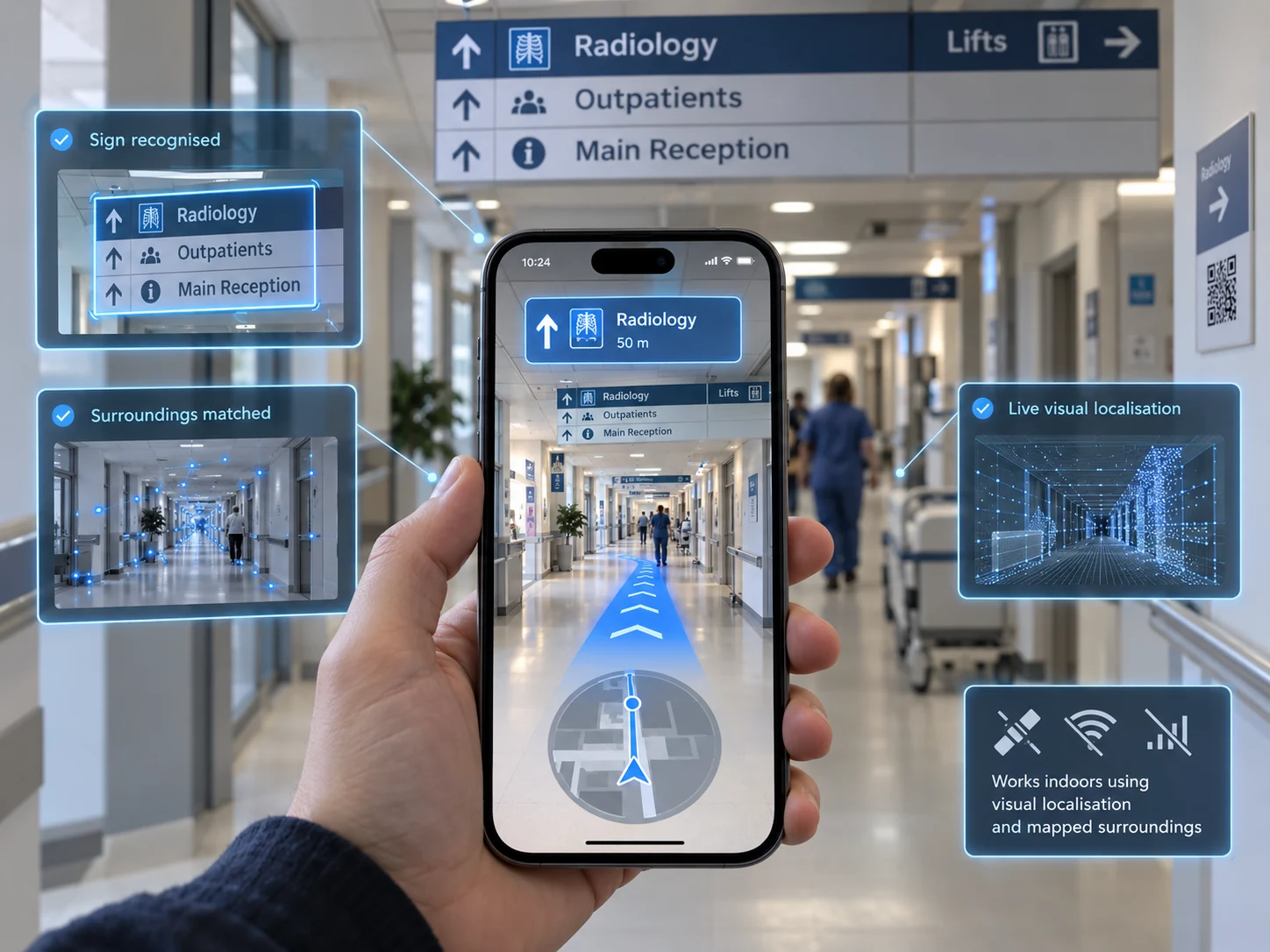
Our research is investigating alternative approaches using visual localisation, environmental recognition and previously mapped spatial information.
The objective is to enable a smartphone to recognise its surroundings and establish its position within the hospital without depending on GPS, Wi-Fi-based location tracking or extensive additional positioning infrastructure.
Existing features such as corridor geometry, entrances and departmental signs may provide useful visual references.
An important research objective is automatic re-localisation: allowing the system to recognise its surroundings and recover its position when navigation tracking becomes uncertain.
Augmented Reality — Simply Follow the Route
The patient-facing experience is designed around simplicity.
Rather than expecting patients to interpret complicated floor plans, the proposed interface could display an illuminated navigation route over the smartphone's live camera view.
Patients would follow clear directional indicators guiding them towards the correct department, reception desk or appointment location.
The system would also investigate:
- Step-by-step guidance between floors and buildings.
- Accessible routes avoiding stairs where required.
- Voice instructions and clear visual guidance.
- Recognition of departmental signs and environmental landmarks.
- Automatic route recalculation when a patient takes a wrong turn.
- Welsh and English language support, with the potential for additional languages.
The aim is to make indoor navigation intuitive, particularly for patients who may be unfamiliar with smartphones or large healthcare buildings.
No Complicated Registration
Accessibility begins before navigation starts.
Our proposed approach would investigate allowing patients to open hospital navigation directly through a web link or QR code, without creating an account or installing a dedicated application.
A patient could arrive at the hospital, open the navigation service, select their destination and receive directions.
Where more advanced positioning or augmented-reality capabilities require a dedicated application, this could be offered as an additional option.
The objective is to minimise barriers to access while retaining the functionality needed for reliable navigation.
AI-Assisted Patient Support
Our vision extends beyond simply guiding patients from one location to another.
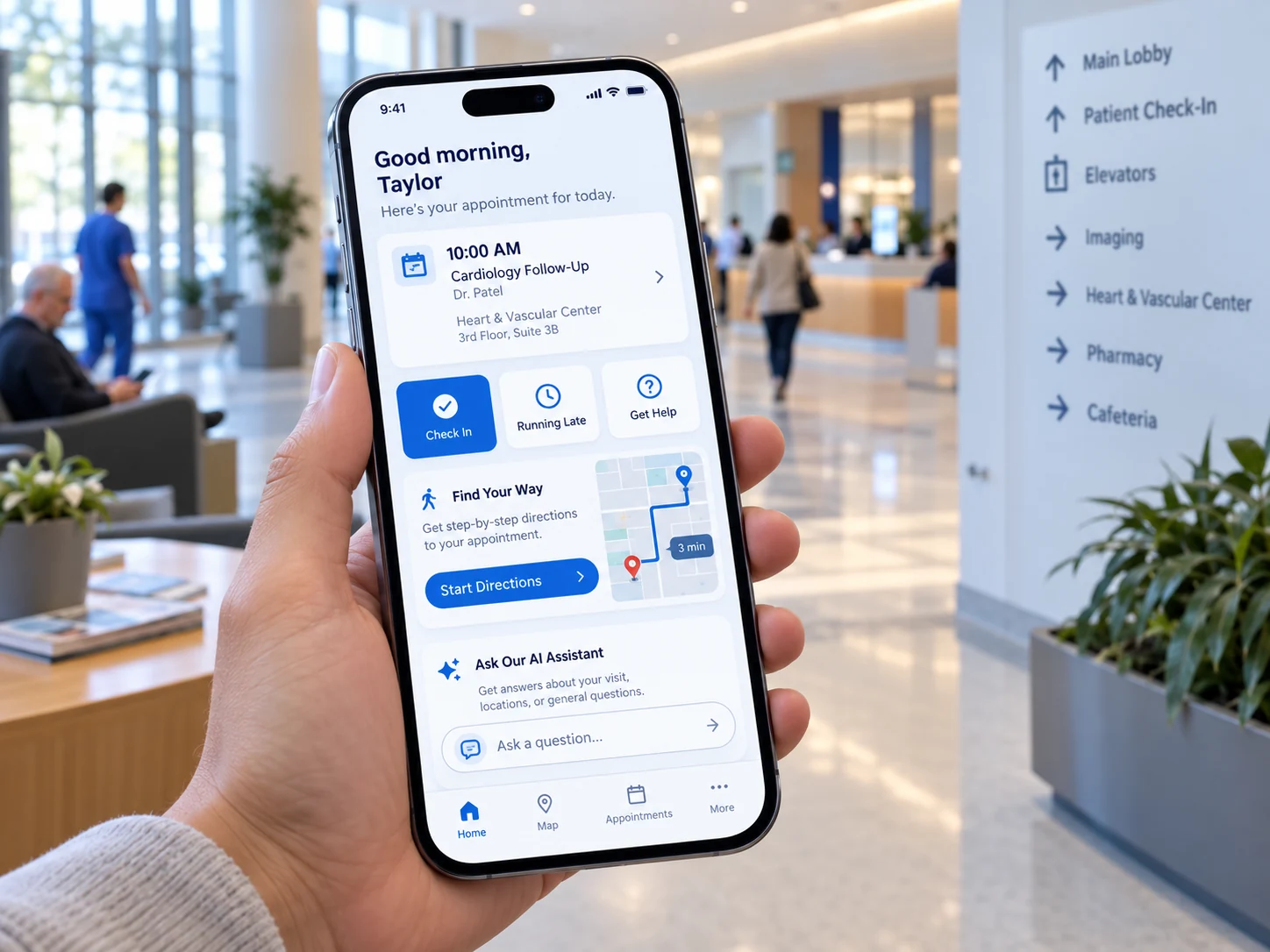
We are exploring how artificial intelligence could assist patients throughout their hospital visit.
Potential features include:
Intelligent Assistance
Patients could ask questions about where they need to go, accessibility requirements or the next stage of their appointment journey.
Running Late Notifications
Patients who anticipate arriving late could notify the hospital directly through the interface, potentially improving communication and reducing administrative workload.
Digital Check-In
Where supported by hospital systems, patients could check in for appointments using the same interface they use for navigation.
Appointment Capacity Management
With suitable integration and hospital approval, the system could help identify opportunities to offer newly available appointment slots to eligible patients waiting for treatment.
Such functionality could potentially reduce unused clinical capacity and contribute to shorter waiting times.
These capabilities would be developed with appropriate data protection, security safeguards and clinical oversight.
Designed for Hospitals That Change
Hospital environments are rarely static.
Departments relocate, corridors change, buildings expand and temporary restrictions alter how people move between locations.
Our proposed mapping architecture aims to make these changes easier to manage.
By developing our own scanning and map-processing tools, we intend to investigate efficient methods for updating individual areas without repeatedly commissioning a complete building survey.
This could provide a practical foundation for scalable deployment across hospitals and other complex public buildings.
Reducing Missed Appointments and NHS Costs
Missed appointments represent a substantial financial and operational burden for the NHS.
An effective patient navigation and assistance system could contribute to:
- Fewer missed and late appointments caused by difficulty finding departments.
- Reduced pressure on staff repeatedly providing directions.
- Improved patient confidence and accessibility.
- Better communication between patients and healthcare providers.
- More effective use of appointment capacity.
- Potential reductions in unnecessary operating costs.
Our research aims to establish whether combining accurate indoor navigation with intelligent patient services can deliver measurable improvements in attendance, patient experience and healthcare efficiency.
Current Development
AVO Invents has undertaken preliminary investigations into 3D scanning, spatial mapping and SLAM-based environment reconstruction.
This early work has helped identify technical challenges and informed our proposed approach to developing dedicated mapping hardware and localisation software.
The project remains at the research and feasibility stage.
The next development objectives are to establish practical mapping methods, investigate smartphone positioning and automatic re-localisation, develop an accessible navigation interface and evaluate potential integration with patient appointment services.
Our long-term ambition is to create a scalable healthcare navigation platform that makes complex buildings easier to navigate while helping healthcare providers use their resources more effectively.